Part 2: China as a Multi-Front National Interest
The fundamental mistake in the current discourse on Philippines–China relations is treating it as if it were only about one issue: the West Philippine Sea. Sovereignty is critically important and non-negotiable. But if the state’s view stops there, the Philippines itself ends up constraining its own development and losing many opportunities that could directly benefit the people.
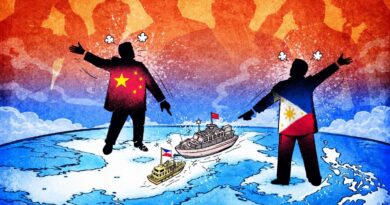
The current tension surrounding the statements of Commodore Jay Tarriela of the Philippine Coast Guard and Chinese Ambassador Jing Quan should not be reduced to a personal dispute. Both officials act as representatives of their respective states. Their words and actions are institutional, not personal. When the discourse is personalized, the Philippines loses diplomatic leverage and strategic clarity.
The responsibility of President Ferdinand Marcos Jr. goes beyond defending territorial waters. His mandate is to manage relations with China across multiple fronts, because that is the reality of geopolitics. The West Philippine Sea is a critical front, but it is not the entire picture of the national interest.
China is one of the Philippines’ largest trading partners. Many jobs in the country are linked to Chinese supply chains—in construction, manufacturing, logistics, and retail. A significant portion of the country’s modernization projects relies on materials and technology from China, whether we like it or not. If China is viewed only as an adversary and not also as an economic partner, it is the ordinary Filipino who will suffer first.
This impact is even more evident in the energy sector. China is currently the global leader in renewable energy—solar panels, wind technology, battery storage, and electric vehicles. While the Philippines has one of the highest electricity costs in Southeast Asia, there is a major opportunity to reduce costs through cheaper and more efficient technologies. Every undisciplined diplomatic tension directly pushes electricity prices higher, costs ultimately borne by the public.
There is also a major opportunity in industrial investment. Because of higher taxes and tariffs imposed by the United States on China, many Chinese companies are seeking new bases in Southeast Asia. The Philippines has the potential to attract factories in electronics, EV components, and renewable energy. But this will not happen if the country projects an image of having no clear separation between security issues and economic policy.
Tourism is another front that directly affects the livelihoods of many Filipinos. China remains one of the largest tourism markets in the region. Each tourist means jobs—in hotels, transport, food services, and local businesses. If relations deteriorate because of personal conflicts and uncontrolled messaging, local communities—not diplomats—are the first to lose.
This is where the role of the Senate must be properly understood. Oversight and defense of sovereignty are important, but they must be disciplined and institutional. When foreign policy becomes a victim of domestic politicking, media grandstanding, or personal score-settling, the nation itself loses. China does not engage personalities; it engages states. When the Philippines’ message becomes muddled by internal noise, its position weakens—even when its legal arguments are strong.
In the end, one point must be clear: the President alone is the sole manager of Philippine foreign policy. The Senate and government agencies assist and provide oversight, but direction, balance, and timing rest with the President. This is how confusion and damaging external signals are avoided.
In managing relations with China, the President should not see this as a new problem alone. The relationship between the Philippines and China is centuries old—older than Spanish colonization. Long before conquest, there was already trade and interaction with Chinese communities. This is a deep and complex history that requires not emotion, but intelligent and disciplined statecraft.
In geopolitics, true strength is not measured by the loudness of one’s voice. True strength lies in state discipline, strategic coherence, and breadth of vision—for the genuine benefit of the Filipino people.