The President’s Health!
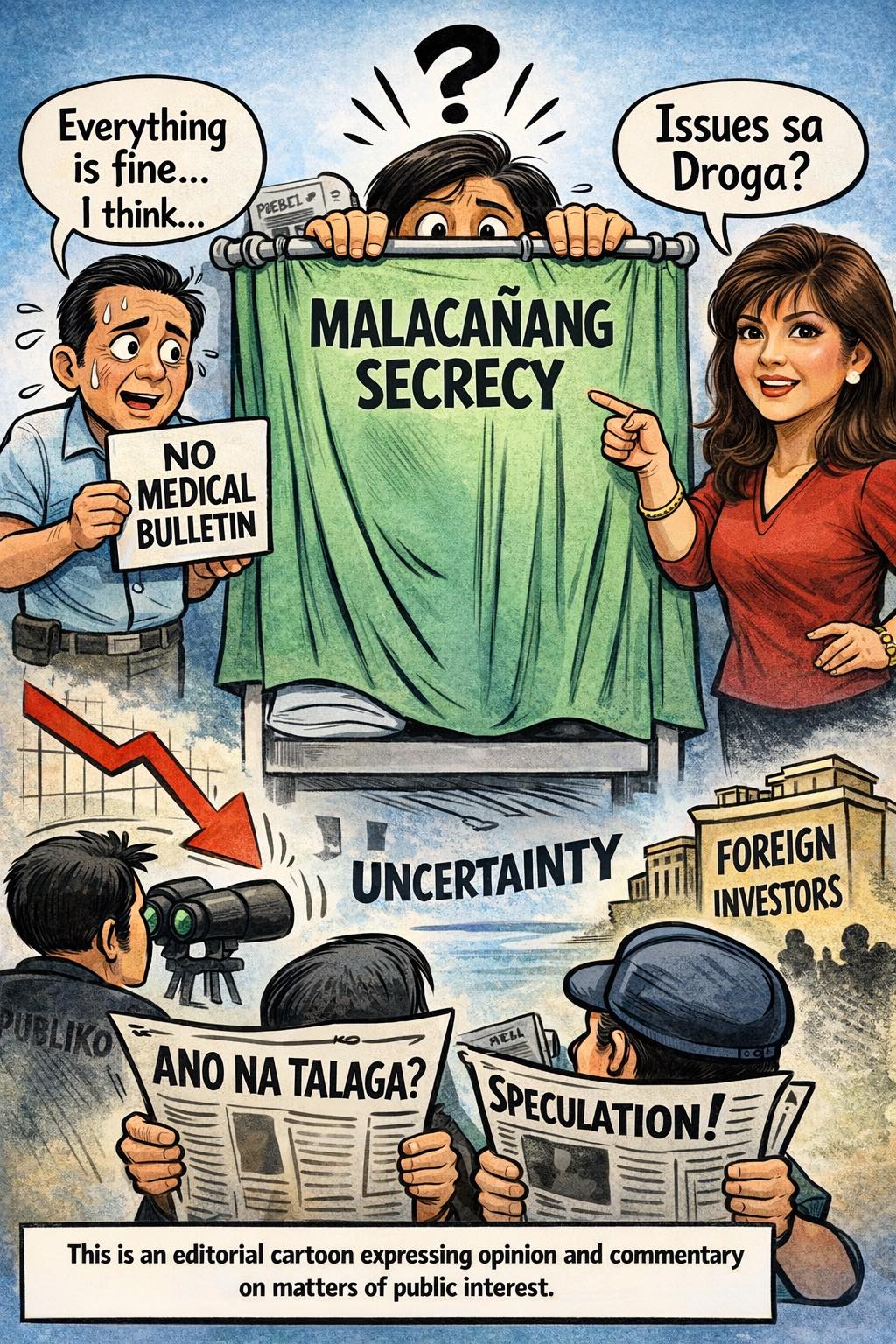
After President Ferdinand Marcos Jr. was hospitalized, Malacañang said there was “no need” to release a medical bulletin. The Palace explained that the President merely experienced discomfort, was placed under observation as a precaution, and soon returned to his official duties.
At first glance, the explanation appears straightforward. But in a democracy, silence from those in power is never merely a personal choice—it is a political strategy.
The issue is made heavier by conflicting statements even within the President’s own family. His sister, Senator Imee Marcos, publicly warned that drug-related issues should not be dismissed. When such statements come from inside the family and the political sphere itself, it is only natural for the public to ask questions.
And those questions are reasonable.
The 1987 Constitution is clear. Article VII, Section 12 provides that “in case of serious illness of the President, the public shall be informed of the state of his health.” This provision exists because the President is not merely a private individual—he is a constitutional institution. His health, whether physical or mental, has direct implications for governance and national stability.
The real issue, therefore, is not whether the President feels well today.
The real issue is who has the authority to decide when the public has the right to know.
It is important to clarify this point: the President himself does not need to be the one to speak. Disclosure does not have to be personal. Malacañang has official spokespersons. More importantly, the Secretary of Health or the Chief Resident Physician of Malacañang can serve as an official, technical mouthpiece on the President’s health.
If the government genuinely wants to avoid speculation and politicization, the institutional pathway already exists. The Department of Health can issue a factual, limited, and professional medical bulletin—one that respects medical privacy while strengthening public confidence.
When the Palace insists that there is “no need” for disclosure despite conflicting statements and public concern, the message is clear: silence is a choice, not the absence of a mechanism, but the preference for political convenience.
This question has been tested before. In De Leon v. Duterte (2020), the Supreme Court ruled that the President cannot be compelled to disclose health information without clear evidence of a serious illness. However, the Court did not abolish the constitutional duty to inform. What it left unresolved—and what politics often exploits—is that the meaning of “serious illness” can shift from a medical standard to a narrative decision.
When Malacañang alone decides what is “serious” and what is not, transparency becomes controlled. Disclosure turns into a favor rather than a duty. The public is left to rely on assurances instead of institutional facts.
No one is asking for medical charts or invasive details. What is being asked is clear, truthful, and official information, issued by the proper office, to affirm that power is governed by law—not by silence.
When there is hospitalization, public concern, and even references to drug issues, yet the people are told they do not need to know, this is no longer about the personal health of a President.