Negative Budgets in the Labor Force: When Work No Longer Pays!
According to a recent OCTA Research survey, most Filipinos now consider higher wages and salaries as the country’s top national concern. This data point is critical because in a country that is often praised for having a “high employment rate,” the public’s real concern is no longer the lack of jobs, but the lack of sufficient income.
In recent years, the prices of food, transportation, housing rent, electricity, and other basic services have continued to rise—a reality also reflected in official inflation data. Wages, however—especially for minimum and near-minimum wage earners—have failed to keep pace with the true cost of living. Whatever modest wage adjustments are granted are often quickly erased by rising prices. This creates the illusion of progress: people are employed, yet their quality of life does not improve.
Data from the Philippine Statistics Authority (PSA) and the Department of Labor and Employment (DOLE) show that the country’s employment rate remains at around 95 percent, meaning the majority of Filipinos have jobs. At the same time, however, about one in every ten workers is underemployed, clear evidence that many are working but still need more hours or additional income just to get by.
The employment rate may be high—but it is only a number. It tells us how many people are working, but not whether those jobs pay enough, are secure, or provide dignity. This is where the real problem begins: the number of jobs has increased, but the value of work has declined.
Many workers classified as “employed” remain underemployed—earning too little to meet basic needs. In everyday reality, many are forced to take multiple jobs, rely on side hustles, or borrow money simply to survive. Employment has become a measure of activity, not of stability.
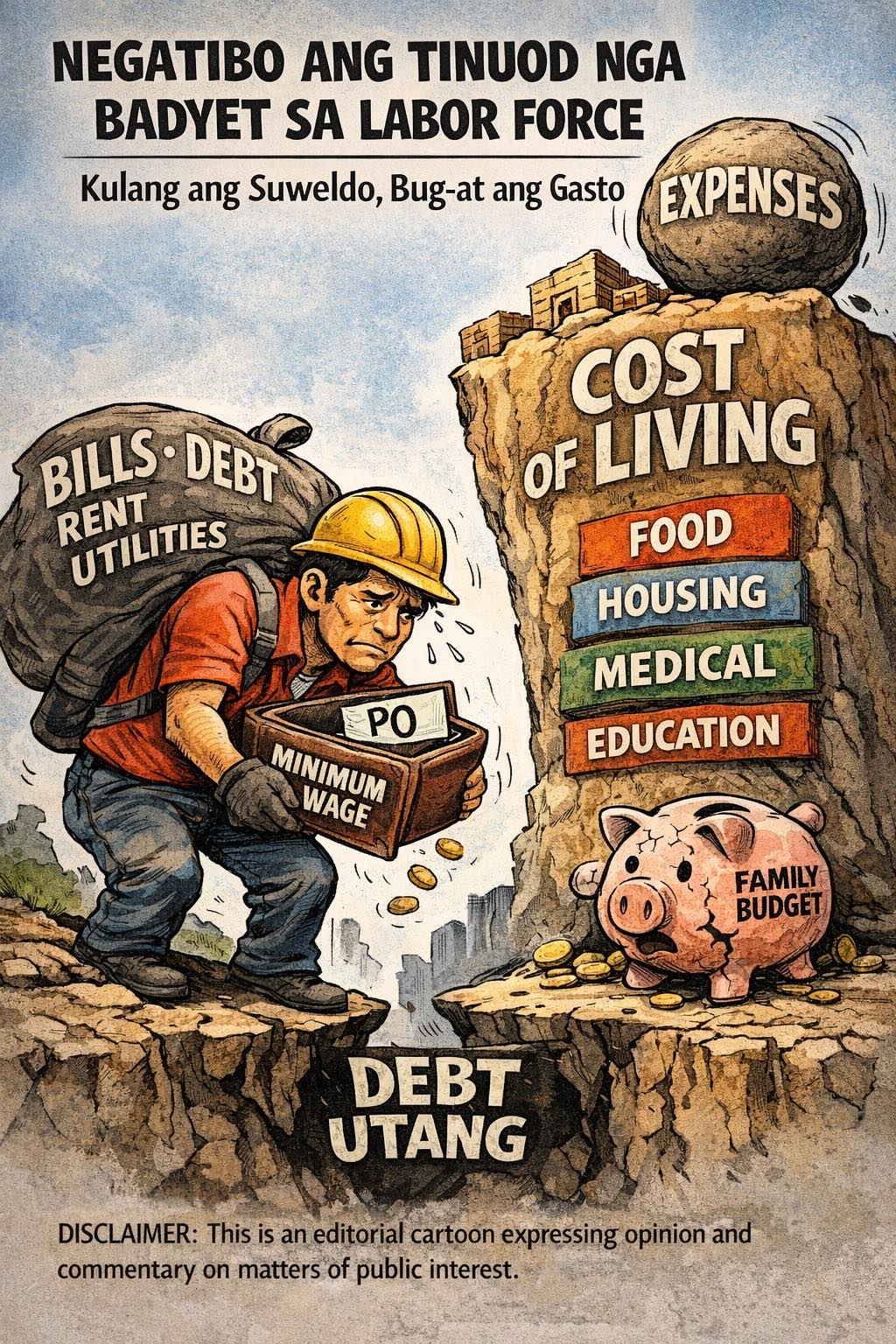
This reality becomes clearer when we look at the actual cost of living in regional cities such as Cagayan de Oro. Despite being perceived as cheaper than Metro Manila, the minimum monthly cost for rent, electricity, water, food, transportation, internet, and basic personal needs ranges from ₱18,000 to ₱20,000. This is not a standard of comfort—it is the bare minimum required to live with dignity.
When compared with the average minimum-wage income, which barely reaches ₱14,000 per month, it becomes clear that the issue is not poor spending habits, but insufficient income. Household budgets are consistently negative. In economic terms, full-time work no longer provides a living wage. A large portion of the labor force has been reduced to survival employment.
The situation worsens further for workers supporting families. In households with two children, the combined cost of food, housing, education, and healthcare quickly exceeds what a minimum wage can cover—even though public education is nominally free, due to real expenses such as transportation, school supplies, and daily allowances. Even in households where both parents work, additional income is often consumed by higher costs for childcare, healthcare, and transportation. A single serious illness, sudden school expense, or temporary job loss is enough to push a family into debt.
This exposes a deeper structural problem: economic risk is gradually being transferred to households. Low wages, limited social protection, and costly healthcare mean that shocks—illness, disasters, or job loss—are absorbed directly by families rather than by the system.
This is why public anxiety persists despite “good numbers.” Employment statistics may offer comfort in political discourse, but they conceal the lived reality of households forced to survive through debt, overcrowded living conditions, and painful compromises in health and education.
In the end, the question is no longer “how many people are employed,” but “what kind of jobs are being created.” The minimum wage was never meant to provide comfort, but it was meant to ensure viability—that full-time work is enough to support basic living needs and family dignity.
The true measure of fixing the system is not a high employment rate, but whether full-time work provides a living wage, real protection, and genuine household stability.
When this fails, employment becomes a statistical success but a social failure.
Work that cannot sustain life is not a sign of a strong economy—it is a clear warning that the system urgently needs correction.