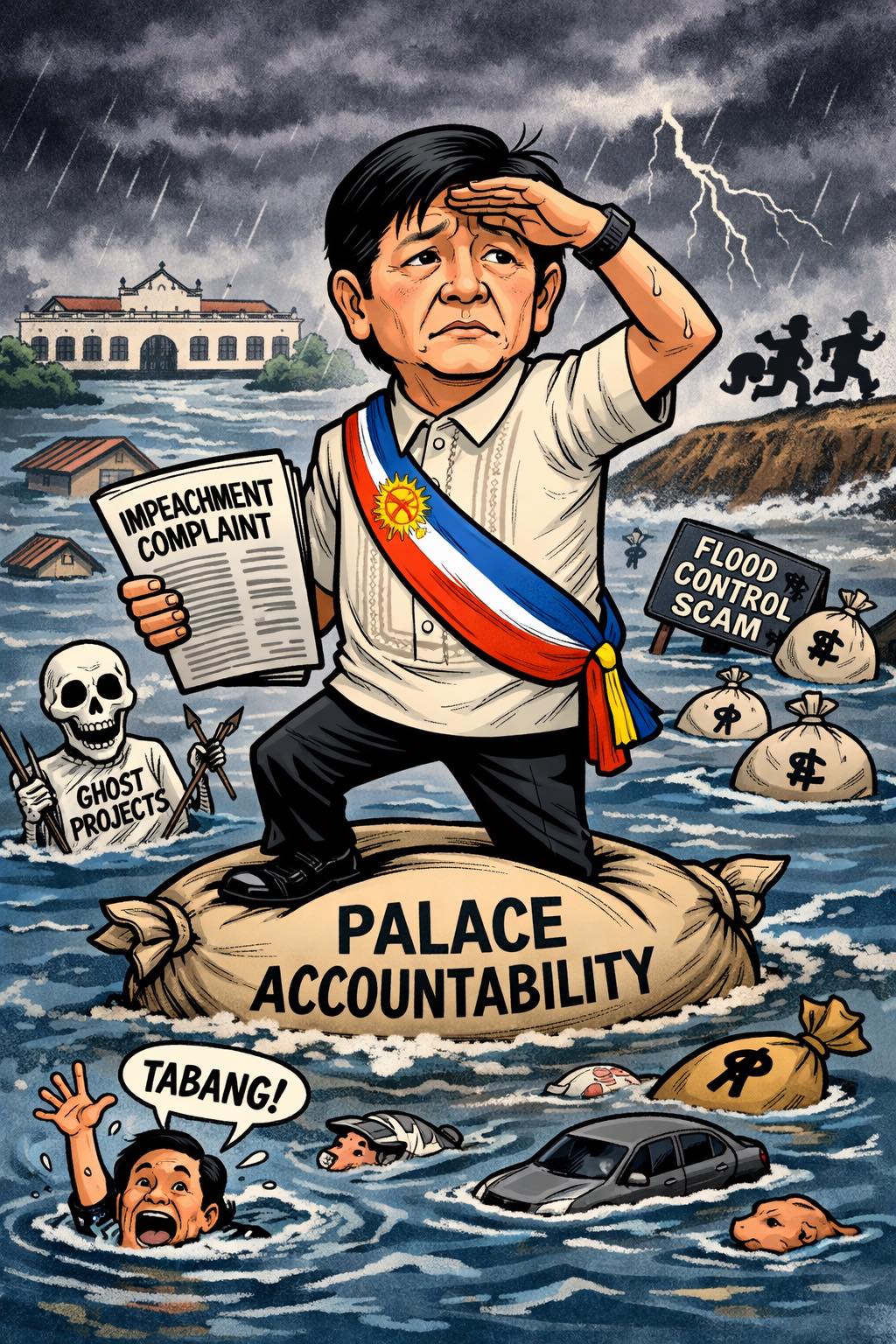
Part 1: Command Responsibility: No One Accountable for the Floods
Recently, a formal impeachment complaint against President Marcos was officially received by the House of Representatives. This is the first impeachment complaint filed against him since the start of his presidency.
The complaint contains allegations of graft and corruption, culpable violation of the Constitution, and betrayal of public trust—grounds that are expressly and clearly provided under Article XI of the 1987 Constitution for impeachable officers.
This is not merely a political issue; it is a constitutional question of accountability.
In every major government scandal, one question is unavoidable: who is accountable? In the ongoing flood control scandal—where billions of pesos’ worth of projects are damaged, substandard, unfinished, or clearly ghost projects despite having been paid—this can no longer be explained as the failure of a few contractors or low-level officials. If the problem is national, accountability must also be national.
Under the 1987 Constitution, the mandate is unambiguous: the President has control over all executive departments, bureaus, and offices. Control is not symbolic and not optional. In legal terms, it means the power to revise, replace, stop, and hold to account all actions within the executive branch. Where there is control, there is an obligation to exercise it; and when that power is not used, inaction itself becomes a failure of accountability.
This is where the doctrine of command responsibility comes in—a principle recognized in law which holds that a leader may be held accountable not only for his direct actions, but also for his failure to prevent or stop wrongdoing committed by subordinates, when he knew or should have known, and had the power to act. The meaning is clear: unused power can be as damaging as abused power.
It is important to clarify that this principle is not limited to the military or the police. In modern governance, the same rule applies when a government program funded with hundreds of billions of pesos shows the same anomalies across regions—substandard materials, overpricing, the same contractors, and the same failed outcomes. This is no longer an isolated incident; it is a systemic failure.
The flood control program is among the largest expenditures of the government. Every year, including in the 2026 national budget, hundreds of billions of pesos are allocated to it. The magnitude of these funds necessarily means there are regular reports, audit findings, red flags, and information that normally reaches the highest levels of the executive branch.
Because of this, the defense of “I did not know” no longer stands—legally or logically. Under the law, when a problem is massive, prolonged, and recurring, the leader is presumed to have known. And when he knew—or should have known—but failed to act, that inaction becomes personal accountability at the highest level of leadership.
An even more troubling point remains: the President is not a passive victim of the system. He has the authority and the power to dismantle it. If the same officials remain in place and the same results continue—flooding, destruction, and tragedy year after year—the situation can no longer be described as mere incompetence. It becomes a deliberate toleration of a broken system.
In constitutional terms, when a leader has the power to stop harm but chooses not to act, inaction itself becomes action. And this is the most dangerous form of failure in leadership accountability.